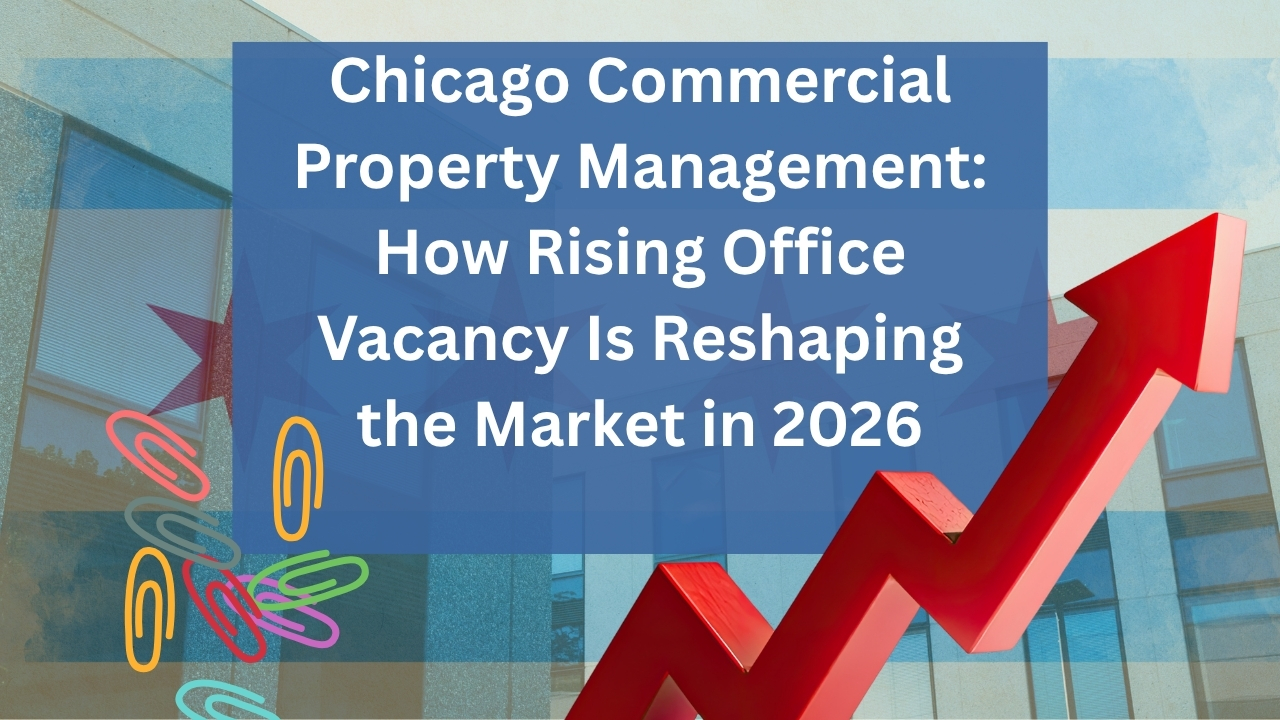
Downtown Chicago’s office vacancy rate has reached a record 28.6%, according to Crain’s Chicago Business.
That number is getting attention across the commercial real estate industry. To be clear, commercial real estate includes lease space for retail properties, office buildings, restaurants, and a broad range of other business uses.
To understand what this new trend really means, owners need to look deeper at the data.
In the broader Chicago commercial real estate market, vacancy rates have been rising for years. The overall office vacancy rate increased from 10.8% in 2018 to over 15.7% by the end of 2024, with Class A office space climbing even higher to 23.6%.
At the same time, leasing activity has slowed. Since 2020, Chicago has seen quarterly leasing volume drop from over 6 million square feet to closer to 4–5 million square feet.
This is not just a short-term fluctuation.
It is a fundamental shift in demand!
Why the Chicago Office Vacancy Rate Keeps Rising

The rise in vacancy rates is largely driven by changes in how businesses use office space.
The pandemic accelerated remote and hybrid work, and many companies have not returned to pre-2020 office usage.
Instead, businesses are:
Reducing their total square footage
Re-evaluating location within the city
Prioritizing flexibility over long-term commitments
This shift has created a growing disconnect between the type of office space available and what tenants are actually looking for in Chicago.
There is still demand in the market.
But it is concentrated in a much smaller segment of properties.
Newer, well-located buildings with updated layouts continue to lease!
Meanwhile, older buildings with outdated floor plans, limited parking, or fewer amenities are sitting vacant for extended periods.
Not All Office Space Is Equal Anymore

One of the most important trends in the Chicago commercial real estate market is the growing divide between high-performing and underperforming properties.
But this divide is not random.
It is happening at a hyper-local level, and in many cases, it comes down to how well a property fits the needs of today’s tenants.
In the city, demand is still strong in neighborhoods where the office experience aligns with lifestyle and convenience.
For example, areas like Lincoln Park and Lakeview continue to attract tenants because they offer walkability, access to transit, and proximity to restaurants and retail. Businesses in these areas benefit from being in locations where employees actually want to spend time, which still holds value even in a hybrid work environment.
By contrast, properties that lack updates or feel disconnected from surrounding amenities are taking longer to lease, even if they are in otherwise strong locations.
We are also seeing a different type of demand in neighborhoods like Logan Square, where smaller, flexible office spaces are appealing to creative users, startups, and hybrid teams. These tenants are often not looking for traditional office layouts. They want adaptable space that matches how their teams operate today.
Where Opportunity Is Growing in the Suburbs

While parts of the city remain competitive, some of the most interesting opportunities right now are in the suburbs.
In areas like Naperville, businesses are finding they can lease newer, well-maintained office space with easier parking, lower costs, and access to a strong local workforce. For many companies, this creates a better balance between cost and functionality.
Further south and west, in markets like Orland Park and Tinley Park, we are seeing demand from service-based businesses and professional users who want to be closer to their customers and employees. These locations offer convenience and accessibility, which are becoming more important than a downtown address.
The shift is even more practical in areas like Bolingbrook, where proximity to major highways and residential growth makes it easier for businesses to operate efficiently without the challenges of downtown commuting.
For many tenants, the decision is no longer about prestige.
It is about practicality.
What Tenants Are Actually Looking For Today

Across both Chicago and the suburbs, tenant expectations have changed in very specific ways.
It is no longer just about having office space.
It is about whether that space works for how people actually operate day to day.
Today’s tenants prioritize:
Layouts that support both collaboration and flexibility
Locations that reduce commute friction, whether through transit or parking
Spaces that feel updated and move-in ready
Practical features that make the office easier to use, not just more attractive
One of the clearest examples of this shift is how much value tenants are placing on access and convenience.
In suburban markets, properties with easy parking and straightforward access often outperform those with more traditional “amenities” that don’t impact daily use.
The gap between properties that lease and those that sit vacant is growing.
But it is not just about location or amenities alone.
It is about alignment.
How This Impacts Commercial Property Owners in Chicago

For commercial property owners in Chicago, rising vacancy rates are not just a market statistic.
They directly impact the performance of your asset.
When office space sits vacant, the costs do not stop. In many cases, they accelerate.
Owners are still responsible for:
Property taxes, which remain among the highest in the country
Ongoing maintenance, including HVAC systems, roofing, and common areas
Utilities for unoccupied space, especially in extreme Chicago winters and summers
Insurance and operational expenses
Debt service, if the property is financed
At the same time, rental income drops to zero for that space.
Even a few months of vacancy can significantly impact annual returns.
For example, a 3,000 square foot office leased at $25 per square foot generates $75,000 annually.
If that space sits vacant for 6 months, that is over $37,000 in lost income, not including operating costs.
And in today’s market, longer lease-up timelines are becoming more common.
Leasing activity across Chicago has slowed from over 6 million square feet per quarter pre-pandemic to closer to 4–5 million square feet today.
That means fewer tenants actively touring and making decisions.
The longer a space sits, the more pressure builds.
Owners may need to reduce rent
Offer concessions or tenant improvement allowances
Invest in upgrades just to stay competitive
This is why commercial property management in Chicago has become more critical than ever.
Managing vacancy is no longer passive.
It requires active strategy, real-time market analysis, and consistent execution.
Why Some Properties Lease While Others Sit Vacant
In today’s Chicago commercial real estate market, vacancy is rarely just about overall conditions.
It is about how a specific property competes.
Two similar buildings in the same submarket can perform very differently based on how they are positioned.
Properties That Continue to Lease
Priced based on current market data, not outdated expectations
Professionally marketed with strong online presence and visibility
Maintained with proactive inspections, especially for major systems like HVAC and roofing
Configured to meet modern tenant needs, including flexible layouts
Located in areas with clear access advantages, whether transit or parking
Properties That Sit Vacant Longer
Priced above comparable properties despite rising vacancy rates
Outdated interiors that require significant tenant investment
Limited marketing exposure or poor listing presentation
Delayed maintenance that impacts tenant perception during tours
Inflexible lease terms that do not align with current tenant demand
In a market where vacancy rates are rising, tenants have more leverage.
They are comparing multiple options and negotiating more aggressively.
That means small disadvantages can quickly become deciding factors.
Where Property Owners Lose the Most Money
One of the biggest mistakes commercial property owners make is underestimating the cost of waiting.
Holding out for higher rent often leads to:
Extended vacancy
Increased concessions later
Higher total loss over time
For example:
Reducing rent by $2 per square foot on a 3,000 square foot space = $6,000 annually
Leaving that same space vacant for 3 months at $25/SF = over $18,000 lost
In most cases, pricing strategically upfront results in a stronger overall return.
The Role of Commercial Property Management

Effective property management plays a direct role in reducing vacancy and improving performance.
A strong management team does more than collect rent.
They actively manage the asset.
Key Commercial Property Management Services
Market analysis and pricing strategy
Leasing and tenant placement
Rent collection and financial reporting
Maintenance coordination and inspections
Compliance with Chicago regulations
Tenant communication and retention
In a competitive market, these services directly impact tenant satisfaction and long-term occupancy.
Tenant Retention Is More Important Than Ever
One of the most overlooked aspects of commercial property management is tenant retention.
Replacing a tenant is expensive.
Between lost rent, leasing commissions, and buildout costs, turnover can significantly reduce profitability.
That is why successful property managers focus on:
Responsive communication
Maintaining building systems (HVAC, roofing, etc.)
Creating a positive tenant experience
Retaining existing tenants is often more cost-effective than finding new ones.
What Chicago Commercial Property Owners Should Do Now

To stay competitive in today’s Chicago commercial real estate market, property owners need to move from passive ownership to active strategy.
Vacancy is no longer solved by simply listing space.
It requires understanding how your specific property competes within your exact submarket.
1. Reevaluate Your Asset Based on Your Exact Submarket
Not all comparisons are equal.
A building in Lincoln Park or Lakeview should not be benchmarked the same way as a property in Naperville or Bolingbrook.
In city submarkets:
Tenants expect updated interiors, natural light, and proximity to restaurants and transit
Walkability and surrounding amenities directly impact leasing velocity
In suburban submarkets like Naperville, Orland Park, and Tinley Park:
Parking availability and ease of access often matter more than walkability
Tenants are comparing value per square foot and total occupancy cost
Property owners should be asking:
What is the current price per square foot for comparable spaces nearby?
How long are similar properties sitting on the market?
What condition are competing listings in?
Without this level of analysis, pricing and positioning decisions are often off.
2. Adjust Your Leasing Strategy to Match Today’s Demand
Leasing activity in Chicago has slowed, and tenants now have more leverage.
That means rigid leasing strategies are leading to longer vacancies.
In today’s market, we are seeing more success with:
Shorter lease terms for smaller or flexible users in areas like Logan Square
Tenant improvement allowances to offset outdated interiors
Structured rent escalations instead of aggressive upfront pricing
In suburban markets like Plainfield or Romeoville, flexibility can be the difference between a signed lease and months of vacancy.
Owners who adapt terms to meet tenant needs are leasing faster than those holding firm on pre-2020 expectations.
3. Invest in Improvements That Actually Impact Leasing
Not all upgrades deliver a return.
The key is investing in changes that directly affect tenant decision-making.
In Chicago neighborhoods like Lakeview and Lincoln Park, that often means:
Updating interiors to feel move-in ready
Improving lighting and layout to maximize usable space
In suburban markets like Bolingbrook and Naperville, high-impact improvements often include:
Clearly marked and accessible parking
Functional layouts that reduce buildout costs for tenants
Exterior updates that improve first impressions
One of the biggest mistakes owners make is investing in amenities that look good on paper but do not influence leasing decisions.
Tenants are prioritizing usability over luxury.
4. Use Real-Time Market Data, Not Outdated Assumptions
Many commercial property owners are still pricing based on what their space leased for several years ago.
That approach is no longer effective.
The Chicago office market has shifted significantly since 2020:
Vacancy rates have increased
Leasing timelines have extended
Tenant expectations have changed
Owners need to regularly review:
Active listings in their immediate area
Recent lease comps (not just asking rents)
Time on market for similar properties
For example, a space in Orland Park sitting for 90+ days is a clear signal that pricing or positioning needs to change.
Data should drive decisions, not assumptions.
5. Partner With a Commercial Property Management Team That Knows the Market
Execution is where most deals are won or lost.
A strong Chicago commercial property management team does more than oversee operations.
They actively:
Monitor leasing activity across submarkets
Adjust pricing and marketing based on real-time feedback
Coordinate maintenance to improve showing conditions
Communicate with prospects and brokers consistently
Identify opportunities to reposition underperforming properties
In a market where tenants are selective and competition is high, these details directly impact how quickly a space leases and how well it performs long term.
The Future of Chicago Commercial Real Estate
The Chicago office market is not disappearing.
It is evolving.
Vacancy rates reflect a shift in demand, not a lack of interest.
Tenants are more selective.
Expectations are higher.
And competition between properties is increasing.
For owners, success will depend on how well they adapt.
Final Thoughts
The rise in the Chicago office vacancy rate is one of the most important trends in today’s commercial real estate market.
But it is not just a challenge. It is an opportunity.
Property owners who invest in strategy, improve their buildings, and work with the right commercial property management team will continue to attract tenants and protect long-term value.
Also note that while office properties have seen the most significant impact, other sectors of commercial real estate have performed very differently. Industrial assets have remained strong due to continued demand for logistics and distribution, while retail has been more mixed, with service-based and convenience-driven businesses continuing to perform well.
This highlights a broader shift across commercial real estate: performance is no longer consistent across asset types, and success depends on how well a property aligns with current tenant behavior and demand.
Work With a Chicago Commercial Property Management Team That Understands the Market

At Landmark Property Management, we help property owners across Chicago reduce vacancies, improve tenant retention, and maximize the performance of their commercial assets.
If your property is sitting vacant or underperforming, our team can help you create a strategy that works in today’s market.
There is also the continued opportunity to convert vacant commercial space into residential space!




.png)